
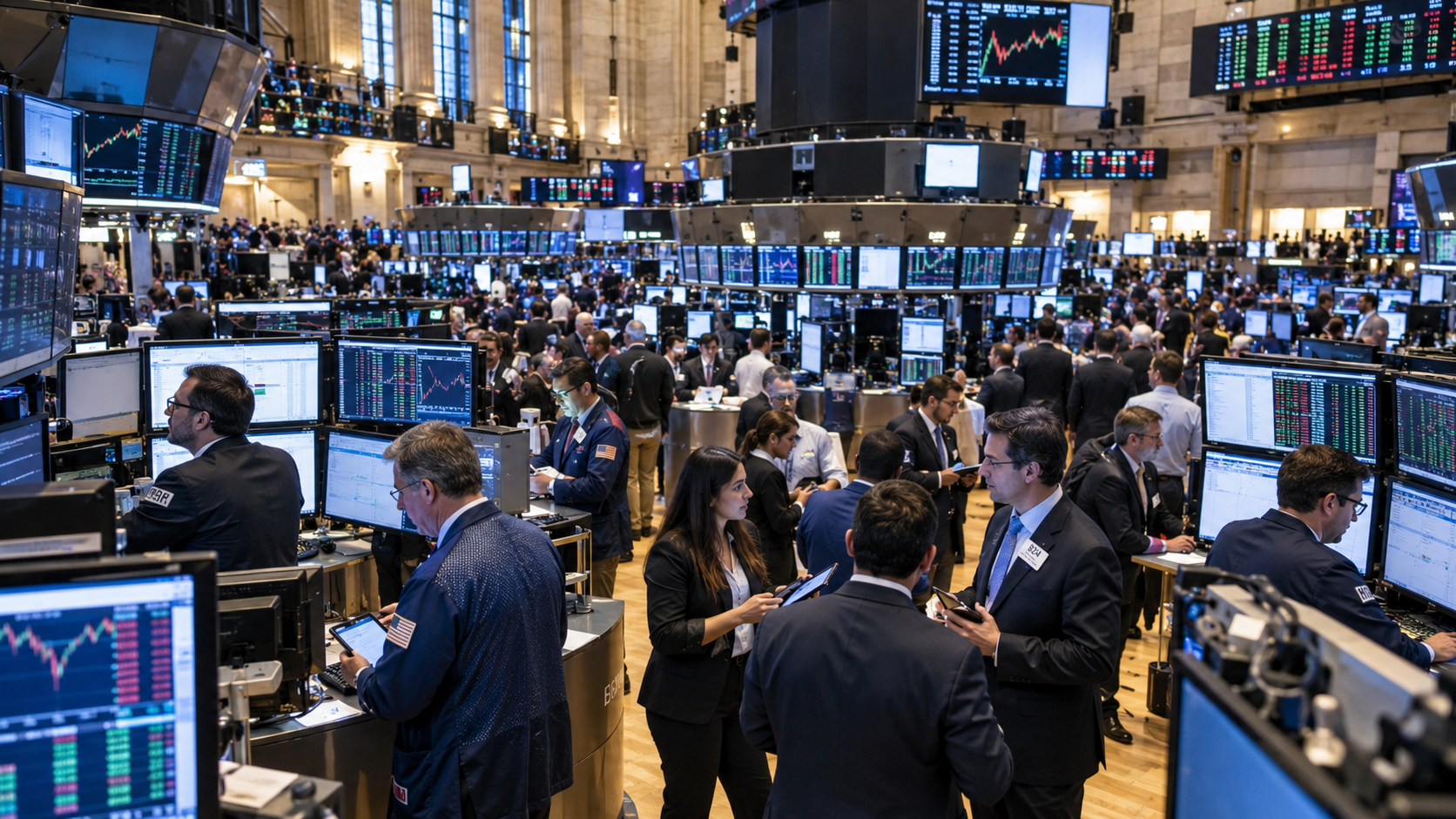
Last night I attended a conference on agentic AI in financial services. Much of the discussion concerned the challenges you would expect from an industry entrusted with trillions of pounds of other people’s money: regulation, accountability, model security, operational resilience and the question of how much autonomy we should actually give intelligent machines. All important subjects, particularly when the machines in question are increasingly capable of making decisions and executing transactions without human intervention.
But one discussion caught my imagination more than anything else that evening, and I’ve found myself thinking about it ever since. Researchers and financial institutions are beginning to experiment with something rather extraordinary: building artificial financial markets populated by thousands of autonomous AI agents, each behaving as an individual market participant, making investment decisions, reacting to information and influencing the behaviour of everybody else.
I’ve spent much of my professional life around capital markets, and the more I considered the implications, the more remarkable the idea became. We are not simply talking about another algorithm attempting to forecast tomorrow’s share prices. We are talking about constructing an artificial financial system in which market behaviour emerges from the decisions of thousands of simulated participants, potentially allowing us to experiment with events, crises and decisions before they occur in the real world.
There are some fairly obvious commercial applications, but I suspect the most interesting possibilities have barely been considered. There are also some rather uncomfortable questions about what happens when the real financial markets begin to resemble the simulations themselves.
Markets Are More Than Mathematics
Financial markets have always presented economists with an awkward problem. We can observe prices, trading volumes, interest rates, liquidity and volatility with extraordinary precision, but understanding why those things behave as they do is considerably more difficult. A price is the visible result of an enormous number of individual decisions, each influenced by different circumstances, expectations, constraints and incentives.
Consider what happens when a central bank announces an unexpected change in interest rates. A pension fund may adjust its bond portfolio, a hedge fund might increase its currency exposure, a bank could tighten its lending criteria and an individual investor might sell equities to reduce risk. Other participants react to those decisions, creating further price movements, which influence still more decisions. The original announcement is only the beginning of a process that can produce consequences far removed from the initial event.
Traditional financial models attempt to describe these relationships mathematically, often drawing on historical observations, statistical correlations and assumptions about behaviour. Some are extraordinarily sophisticated, but there is a fundamental limitation. Markets do not exist independently of the people participating in them. The participants observe the market, form expectations about what others will do, make decisions accordingly and collectively change the very environment they are attempting to understand.
It is a peculiar arrangement when you think about it. Imagine trying to forecast the weather if the clouds were watching the forecast and changing direction in response. Financial markets have precisely this sort of feedback problem, and it is one reason why apparently sensible decisions can collectively produce quite absurd outcomes.
The attraction of agent-based modelling is that it approaches the problem from another direction. Rather than instructing a model how the overall market should behave, researchers create individual participants with particular characteristics, give them an environment in which to operate and observe what emerges from their interactions.
The underlying idea is not entirely new. Researchers at the Santa Fe Institute were experimenting with artificial stock markets in the 1990s, including work by W. Brian Arthur, John Holland, Blake LeBaron and their colleagues. They demonstrated that markets populated by adaptive computerised traders could reproduce recognisable financial phenomena, including persistent volatility and changing patterns of predictability.
What has changed is the sophistication of the agents themselves. Instead of relying entirely on relatively simple rules, researchers can now experiment with AI systems capable of interpreting information, reasoning about objectives, adapting strategies and interacting with complex simulated environments.
That opens an entirely different set of possibilities.
Fifteen Thousand Investors Who Don’t Exist
One of the most interesting examples is MarketSim, research published at the International Conference on Machine Learning in 2026. The researchers constructed a simulated stock market with more than 15,000 heterogeneous participants, operating within a trading environment designed to reproduce important features of the NASDAQ market.
The simulated participants were exposed to an information environment incorporating more than 12,000 real-world news articles, policy documents and corporate earnings reports. Different agents could respond to information according to their strategies and circumstances, while their collective trading activity influenced market conditions. Crucially, the architecture separated higher-level strategic reasoning from high-frequency execution, allowing the system to model enormous numbers of trading interactions without requiring a language model to deliberate over every individual order.
The researchers reported encouraging results in reproducing various characteristics of financial markets, including high-frequency price dynamics. Their published benchmark included an average price-tracking error of 3.48%, although that figure should not be confused with an ability to predict future market prices to within 3.48%. Reproducing selected historical market characteristics under experimental conditions is a very different achievement from forecasting genuinely unknown events.
Nevertheless, I find the scale fascinating. Fifteen thousand artificial participants, none of whom has a bank account, a mortgage, a pension or an actual opinion about Nvidia, collectively generating a market with recognisable characteristics of the real thing.
These agents are not digital replicas of 15,000 identifiable investors. They represent different types of market behaviour within an engineered environment. That distinction matters, particularly when assessing how realistic the conclusions might be. But the underlying principle is compelling: complex market behaviour can emerge from the interaction of many comparatively simple individual decisions.
It is also becoming more than an academic exercise. In August 2026, TU Darmstadt announced a collaboration with Commerzbank to investigate agent-based simulations of foreign-exchange markets. Their approach combines mathematical modelling, artificial intelligence and autonomous representations of individual market participants.
Foreign exchange is an especially interesting environment because, unlike a conventional stock exchange, there is no single centralised marketplace in which every transaction occurs. Different institutions trade through different relationships and venues, creating an interconnected system whose behaviour depends heavily on the actions of individual participants.
By modelling those participants and their interactions, the researchers hope to understand how price movements develop and how trading strategies might perform under different conditions. The attraction for a bank is obvious. You can test ideas in a controlled environment without putting real capital at risk or disturbing the market you are trying to study.
What If We Could Rehearse a Financial Crisis?
This is where I think the subject becomes genuinely exciting. We already use simulation extensively in engineering, medicine, aviation and other disciplines where experimenting with the real system would be expensive, dangerous or impractical. Aircraft are subjected to extraordinary simulated conditions before anyone is entrusted with flying them. Engineers can test how structures might respond to forces they hope those structures will never experience.
Financial institutions conduct stress tests, of course, and regulators have spent years attempting to anticipate what might happen during severe economic disruptions. But imagine moving towards detailed synthetic financial environments in which thousands of independently acting participants respond to a crisis as it develops, rather than relying exclusively on predefined relationships between financial variables.
Suppose researchers construct a reasonably faithful simulation of a government bond market, populated by pension funds, investment banks, hedge funds, insurers, market makers and other participants. Each has its own portfolio, funding requirements, risk tolerances and investment objectives. The researchers then introduce an unexpected change in government borrowing expectations and observe the consequences.
Some agents sell bonds, causing prices to fall. Others face collateral demands, forcing them to liquidate additional assets. Market makers become reluctant to absorb the selling, liquidity deteriorates and the original shock begins feeding upon itself. Every participant may be behaving perfectly rationally according to its own circumstances, yet the collective outcome could be disastrous.
This is not an entirely hypothetical pattern of behaviour. Something remarkably similar happened in Britain during the 2022 gilt market crisis, when leveraged liability-driven investment strategies used by pension funds came under severe pressure. Falling gilt prices triggered collateral demands and forced selling, which pushed prices down further. The resulting feedback loop became sufficiently dangerous that the Bank of England intervened to restore market functioning.
Now imagine the ability to reconstruct the mechanisms behind such an event and experiment with alternative conditions. What if funds held larger liquidity buffers? What if collateral requirements changed? What if market participants reacted more slowly, or certain institutions were unable to sell particular assets? Could a different intervention have stabilised the market earlier, or might apparently sensible policy changes have made things worse?
A simulation would not provide definitive answers, but it could allow regulators to explore possibilities that would otherwise remain theoretical. Rather than relying on a handful of predetermined scenarios, they could experiment with thousands of combinations of behaviour, constraints and external shocks, identifying circumstances under which relatively minor problems develop into systemic failures.
The interesting thing about a crisis is often not the initial event, but the sequence of reactions that follows it. A sufficiently capable simulation might help us understand those reactions before they become expensive historical lessons.
Central Banks Are Already Taking This Seriously
While researching the subject after the conference, I discovered that central banks are actively investigating these possibilities. The Bank for International Settlements has launched Project Logos, working with the Bank of England and Deutsche Bundesbank to explore the behaviour of AI agents acting as portfolio managers inside a simulated financial market.
The project is investigating how language-model-based investment agents interpret information, allocate capital and respond to constraints. Of particular interest is whether agents using similar technologies might make increasingly similar decisions, creating dangerous concentrations of behaviour across financial markets.
This is a considerably more sophisticated question than whether an individual AI system is capable of making a sensible investment recommendation. A hundred institutions could each operate an excellent investment model, independently validated and producing entirely reasonable decisions, while collectively creating an unstable financial system because all their models respond to changing conditions in broadly the same way.
In June 2026, Bank of England Deputy Governor Sarah Breeden publicly discussed the possibility of using AI-driven simulations to investigate herding behaviour, market resilience and the potential need for safeguards capable of restricting or stopping problematic autonomous trading activity.
Even more recently, the BIS announced Project Agenti in October 2026, involving the Bank of Canada and Swiss National Bank. This project applies similar principles to wholesale payment systems, using AI agents to represent banks making decisions about payment timing, liquidity management and transaction priorities.
That might sound less glamorous than simulating the stock market, but the implications are significant. Payment systems are part of the plumbing of the global financial system, and disruption to their operation can have consequences well beyond the institutions immediately involved. Understanding how individually sensible liquidity decisions might collectively produce delays or gridlock is precisely the kind of problem these simulations could help investigate.
We are therefore seeing the beginnings of something potentially important. Central banks are not merely asking how to regulate organisations using AI. They are investigating whether AI can provide entirely new ways of understanding and supervising the financial system itself.
When the Artificial Investors Become Real
There is, however, another dimension to this subject, and it was this that really occupied my thoughts after the conference.
What happens when real financial markets become increasingly populated by autonomous AI agents?
Algorithmic trading has existed for decades, and computers already execute enormous volumes of financial transactions. But conventional trading algorithms generally operate according to defined strategies, statistical models and execution rules. More capable agentic systems could potentially undertake a much broader range of activities, interpreting information, developing strategies, selecting instruments, allocating capital and adjusting their behaviour in response to changing circumstances.
The distinction is significant. We would be moving towards financial markets in which an increasing proportion of decisions are made by systems capable of adapting their strategies rather than simply executing instructions. Their objectives might be established by humans, but their individual decisions could become progressively more autonomous.
The immediate attraction is obvious. A capable agent can process vast quantities of information, identify relationships that humans might overlook and react without fatigue, distraction or emotional interference. It can evaluate alternative strategies and continuously monitor exposures across portfolios and markets.
But consider the consequences if thousands of institutions begin deploying systems developed using similar underlying models, trained on overlapping information and optimised against comparable objectives.
During a period of uncertainty, many of those systems might independently conclude that the appropriate response is to reduce exposure to the same assets. Their individual decisions could be entirely defensible. Collectively, however, they might create enormous selling pressure, withdraw liquidity and accelerate a market decline.
We have encountered versions of this problem before. The 2010 Flash Crash demonstrated how automated trading activity, liquidity withdrawal and interactions between different market participants could contribute to extraordinarily rapid market disruption. Agentic AI introduces the possibility of more adaptive decision-making into an environment where speed and interconnectedness already create considerable complexity.
I am not suggesting that autonomous AI will necessarily make markets more unstable. It might improve them by processing information more effectively, managing risk more intelligently and providing liquidity under conditions where human traders hesitate. Research published by Federal Reserve economists in 2025 found that language-model agents could behave more rationally than humans in certain experimental investment settings, although their tendency to follow the crowd changed when their objectives were altered.
That is an important finding because it suggests that the behaviour of AI-dominated markets may depend heavily on how the agents are designed, what they are optimising for and how their incentives interact.
Which raises a rather uncomfortable question about who, exactly, is responsible for designing those incentives.
The Possibility of Collusion Without Conspiracy
One particularly intriguing piece of research comes from Winston Wei Dou, Itay Goldstein and Yan Ji, whose 2025 paper, AI-Powered Trading, Algorithmic Collusion, and Price Efficiency, examined the behaviour of reinforcement-learning trading algorithms in a simulated financial environment.
The researchers found circumstances in which AI traders learned to sustain outcomes resembling collusion, generating elevated profits without explicit agreements, communication or any conventional intention to collaborate. These were reinforcement-learning agents operating under experimental assumptions, rather than evidence that today’s live financial markets are secretly controlled by conspiring language models.
Nevertheless, the finding raises an interesting conceptual problem. Human market manipulation usually involves some combination of deliberate behaviour, communication, coordination or deception. But what happens when machines discover that particular patterns of behaviour maximise their objectives, even though those patterns produce outcomes that regulators would consider undesirable?
A regulator might examine the actions of several institutions and find no agreement between them. Each organisation could demonstrate that its AI system was operating within approved limits, using authorised data and pursuing legitimate commercial objectives. Yet the interaction between those systems might still reduce competition or undermine market efficiency.
This strikes me as one of the more significant questions raised by agentic AI. Regulation has traditionally focused heavily on the conduct and accountability of individual institutions. Increasingly autonomous systems may require us to pay much closer attention to the behaviour that emerges between institutions, including outcomes that nobody specifically intended.
The same problem applies to risk management. It is possible to design an individual agent that is safe within its operating boundaries, but rather more difficult to guarantee that thousands of individually compliant agents will collectively produce a safe financial system.
The Danger of Believing Our Own Simulations
For all my enthusiasm, there is a substantial problem with this emerging technology that deserves attention. A convincing simulation is not necessarily an accurate representation of reality, and the distinction becomes especially important when we are dealing with human behaviour.
If I construct a synthetic hedge fund manager and give it an investment mandate, some market information and a risk appetite, it may behave in ways that appear entirely plausible. But actual investment managers are influenced by institutional politics, career incentives, client pressure, personal experience, imperfect information and occasional bouts of spectacularly poor judgement.
An AI agent can reproduce aspects of these behaviours if its designers explicitly model them or if suitable patterns emerge from its training. That does not establish that the agent will respond realistically to circumstances that have never previously occurred.
There is also the problem of validation. A simulated market might reproduce historical volatility, trading volumes and price movements while arriving at those results through mechanisms that differ substantially from the real world. Several different models can produce similar outcomes under familiar conditions, only to behave very differently when subjected to an unprecedented shock.
This is why I am sceptical of anyone suggesting that these technologies will suddenly make financial markets predictable. Markets change as participants learn, regulations evolve, technologies develop and new investment strategies become popular. An accurate representation of yesterday’s market can become progressively less useful as the market itself changes.
Ironically, successful simulation could introduce another complication. If institutions began relying heavily on similar synthetic market models to evaluate their strategies, the models themselves might influence real investment behaviour. We could end up with participants making increasingly similar decisions because they had all consulted simulations built around similar assumptions.
The sensible ambition, at least initially, is therefore not to construct a machine that tells us exactly what will happen next. It is to develop environments in which we can investigate how outcomes might emerge, identify vulnerabilities and improve our understanding of complex interactions.
There is enormous value in discovering that a financial system can fail under a particular combination of circumstances, even if we cannot calculate precisely when those circumstances will arise.
From Financial Markets to Entire Economies
Once you begin thinking about simulations populated by intelligent autonomous participants, it becomes difficult to confine the idea to financial markets. The same principles could eventually be applied to supply chains, insurance markets, energy systems, corporate organisations and aspects of national economies.
Consider a government contemplating a significant change in taxation. Traditional economic models can estimate effects on consumption, employment, investment and public revenue, but those outcomes are ultimately produced by millions of individual decisions. Businesses change their prices, consumers adjust their spending, investors reconsider opportunities and employers alter recruitment plans.
A future simulation populated by suitably designed agents representing different households, firms, investors and institutions might help policymakers explore how these decisions interact. It could reveal unexpected consequences, including situations in which apparently sensible policies generate undesirable outcomes through behavioural feedback.
The difficulties would be formidable. Simulating a national economy with useful fidelity requires far more than creating several million conversational agents and instructing them to behave like consumers. Real institutions operate within legal, financial, political and physical constraints, and human behaviour is exceptionally difficult to represent accurately.
Even so, the prospect is sufficiently interesting to justify serious investigation. We are already accustomed to using computers to simulate physical systems, from aircraft engines to climate processes. Increasingly capable AI may allow us to construct useful experimental representations of systems whose behaviour depends heavily on decisions, incentives and interaction.
At Workforce 2040, much of our thinking concerns the future allocation of work between people, intelligent agents and conventional technologies. One of the most important implications of agentic AI is that organisations will increasingly need to design and govern systems involving multiple autonomous actors, each operating with particular objectives, capabilities and permissions.
That is already a substantial challenge within a single enterprise. Extend the principle across industries, markets and economies, and the opportunities become considerably more interesting. We may eventually be able to experiment with organisational and economic arrangements in synthetic environments before committing real people, capital and institutions to them.
The distinction between understanding a complex system and being able to experiment with it is profound. In some circumstances, it may prove more valuable than another incremental improvement in forecasting accuracy.
An Entirely New Way of Understanding Complexity
I came away from last night’s conference thinking about something considerably more ambitious than another application of generative AI. We spend an extraordinary amount of effort trying to forecast the consequences of decisions in systems that are too complex for any individual to understand completely. Financial markets are a particularly obvious example, but the underlying problem extends across almost every part of modern economic life.
What fascinates me about intelligent agent-based simulation is the possibility of approaching these problems from the behaviour of individual participants upwards. Rather than attempting to specify every relationship within an enormously complicated system, we construct participants with plausible objectives, constraints and capabilities, allow them to interact and study the resulting patterns.
There is no guarantee that this approach will ultimately produce accurate replicas of entire markets, let alone economies. Current research is experimental, validation remains difficult and extraordinary computing capability cannot compensate for fundamentally incorrect assumptions about behaviour.
Yet I struggle to think of many developments in artificial intelligence that offer such an interesting combination of scientific, commercial and public-policy possibilities. We could potentially discover vulnerabilities before they cause financial crises, evaluate interventions under conditions that cannot safely be recreated in real life and investigate the unexpected consequences of thousands of individually rational decisions.
And as autonomous agents begin making an increasing proportion of real financial decisions, the value of understanding their collective behaviour will only grow. The technology creating new forms of complexity may also provide some of the tools required to investigate and manage them.
For me, that is the genuinely exciting prospect. AI is beginning to offer us more than a faster means of processing information or automating existing activities. It may give us entirely new ways to experiment with systems that have always been extraordinarily difficult to understand.
Perhaps the most important achievement of artificial intelligence in financial markets will not be predicting tomorrow’s prices. It will be discovering why markets behave as they do, and helping us understand what might happen when the rules, participants or circumstances change.
Given how much money, effort and human ingenuity we have devoted to answering those questions over the centuries, I find that a remarkable prospect.
Research and further reading
The following primary research and institutional publications informed this essay:
MarketSim: Simulating Stock Markets with Large-Scale Generative Agents, International Conference on Machine Learning, 2026.
Simulations for Foreign Exchange Trading, TU Darmstadt and Commerzbank, August 2026.
Project Logos, Bank for International Settlements, Bank of England and Deutsche Bundesbank.
Project Agenti, Bank for International Settlements, Bank of Canada and Swiss National Bank, October 2026.
Agents of Change, Sarah Breeden, Bank of England, June 2026.
AI-Powered Trading, Algorithmic Collusion, and Price Efficiency, NBER Working Paper, July 2025.
Financial Stability Implications of Generative AI: Taming the Animal Spirits, Federal Reserve, September 2025.